
Companion Plants
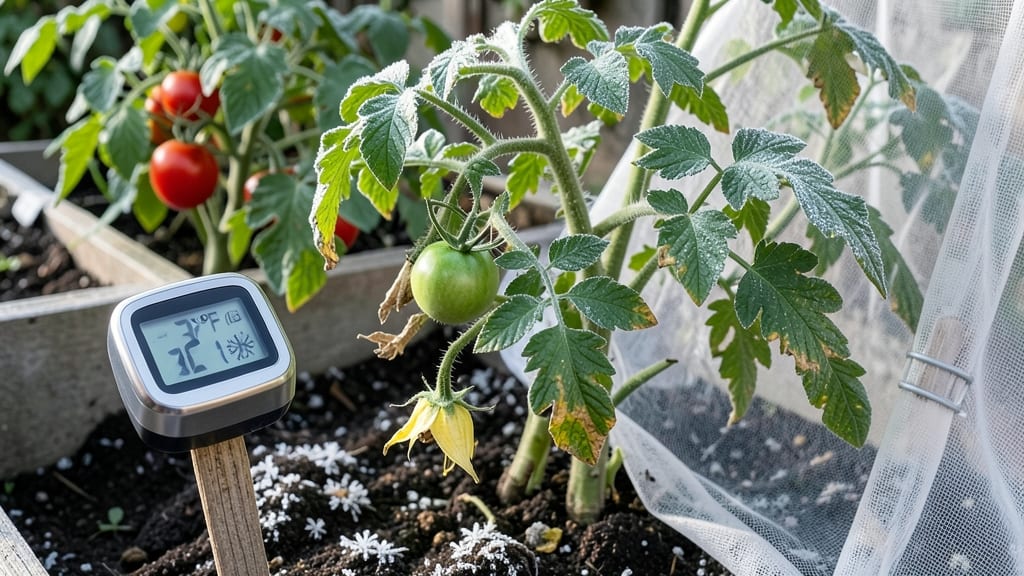
Tomato plants suffer damage when the temperature is too cold for them, dropping below 50°F (10°C), with severe harm at 40°F (4°C) or lower. Frost (32°F/0°C) will kill most varieties, while nighttime lows under 55°F (13°C) stunt growth and reduce fruit production.
Cold weather disrupts tomato plants at a cellular level—below 50°F (10°C), their metabolic processes slow dramatically, and the leaves start showing dark spots or wilting. 🌱 The real danger zone begins at 40°F (4°C), where protein structures in plant cells begin to break down, leading to irreversible damage.
Nighttime temperatures matter most because tomato plants rely on warm days to recover from cooler evenings, which is why even 55°F (13°C) nighttime lows can stress them enough to cut back on flowering and fruiting.
This sensitivity explains why gardeners in cooler climates often choose cold-hardy varieties like 'Siberian' or 'Stupice,' which can tolerate brief dips to 32°F (0°C)—though even these won't survive prolonged frost. The key is protecting your plants before temperatures drop, whether through row covers, mulching, or moving potted plants indoors.
Humidity plays a role too: dry cold air accelerates moisture loss, making plants more vulnerable to cold stress.
💡 In This Article
- Tomato Plant Cold Sensitivity: How Temperature Affects Growth and Survival
- Protecting Tomato Plants from Cold Weather: Practical Solutions
Tomato plant cold sensitivity: how temperature affects growth and survival
Tomato plants are tropical by nature, meaning their ideal growing range sits between 70-85°F (21-29°C). When temperatures dip below 50°F (10°C), their cellular machinery starts to falter.
The first visible signs appear as dark, water-soaked spots on leaves—this occurs when cold temperatures disrupt the plant's photosynthetic efficiency by up to 40%.
The real damage happens at the molecular level: cell membranes become rigid, and enzymes responsible for growth begin to denature, especially below 40°F (4°C). 🌱
Nighttime temperatures have a more dramatic impact than daytime highs because tomato plants rely on warm days to recharge their energy reserves. A 55°F (13°C) night might seem mild, but it can still stress plants enough to halt flowering and reduce fruit set by 30-50%.
This is why gardeners in cooler climates often see stunted growth or fewer tomatoes—even if daytime temps are perfect. The root system, which thrives in 60-70°F (15-21°C) soil, also slows down, limiting nutrient and water uptake.
Humidity worsens the problem: dry cold air accelerates transpiration (water loss), making plants more vulnerable to cold shock.
At 40°F (4°C), protein structures in plant cells begin to unfold and degrade, leading to irreversible damage within 24-48 hours. This is why even brief cold snaps can kill young plants or stunt mature ones.
The critical threshold for most tomato varieties is 32°F (0°C)—frost causes ice crystal formation in cells, rupturing them like a frozen balloon. 💧 Cold-tolerant varieties like 'Siberian' or 'Stupice' can handle brief dips to this temperature, but prolonged exposure will still kill them.
The key difference is that these varieties recover faster from mild cold stress due to higher levels of antioxidants that protect cell membranes.
What most gardeners don't realize is that temperature fluctuations are just as damaging as steady cold. A 10°F (5.5°C) swing between day and night can disrupt the plant's circadian rhythm, causing blossom drop and poor fruit development.
This is why microclimates matter—plants near walls, fences, or mulched beds may experience 5-10°F (3-5.5°C) warmer nighttime temps than those in open areas. Even a well-drained, mulched bed can keep root zones 5-7°F (3-4°C) warmer than exposed soil, giving plants a critical survival edge.
Another critical factor is soil temperature. Tomato roots stop absorbing nutrients effectively below 55°F (13°C), even if air temps are warmer. This is why black plastic mulch or straw mulch is so effective—it raises soil temps by 5-10°F (3-5.5°C) by trapping heat.
Without this protection, roots become sluggish, and the plant's ability to transport water and nutrients to leaves and fruit is severely compromised. 🌿 The result? Wilting, yellowing leaves, and reduced fruit quality—even if the plant survives.
Understanding these mechanisms helps explain why some tomato plants look healthy one day and suddenly collapse the next after a cold snap. The damage isn't always immediate—it builds over time as cellular functions degrade.
This is why proactive protection (like row covers or cold frames) is far more effective than waiting for symptoms to appear. The goal isn't just to keep plants alive but to preserve their ability to grow, flower, and produce fruit—even in marginal climates.