
Pruning
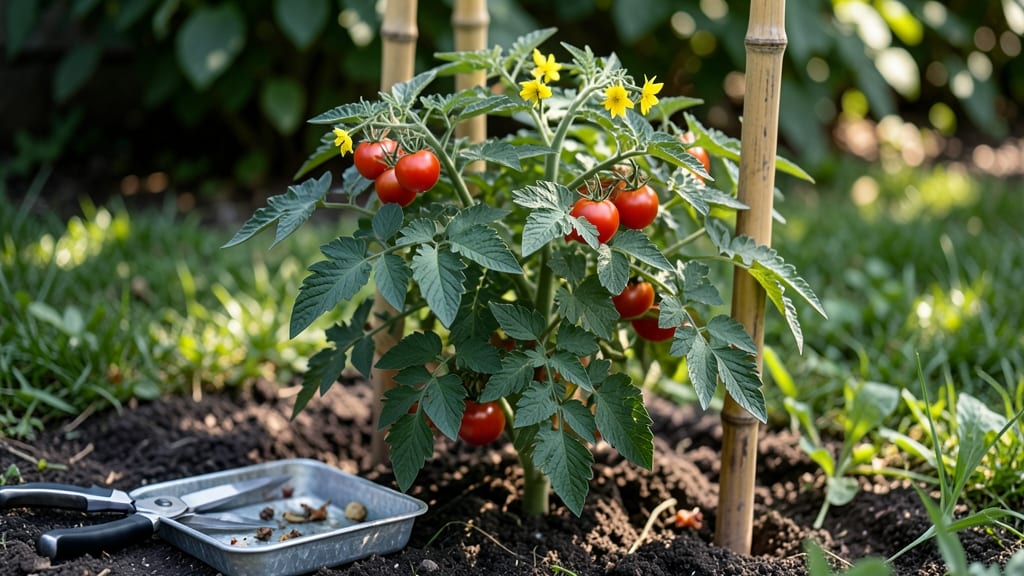
Pruning determinate tomato plants means making only light cuts to preserve their natural bush shape, removing only diseased leaves and suckers that form below the first flower cluster. Heavy pruning weakens these plants, cutting fruit production by up to 30%, so focus on airflow and sunlight access instead.
Determinate tomatoes grow in a compact, self-supporting form—think of them as the "set and forget" variety compared to their vining indeterminate cousins. 🌱 The key is working with their natural growth pattern rather than against it.
Unlike indeterminate plants that keep growing taller, determinates produce all their fruit at once, so aggressive pruning can actually reduce your harvest by redirecting energy away from fruit development.
Instead, think of pruning as maintenance: snip off only the worst offenders (like yellowed leaves or moldy stems) and let the plant’s bushy structure do the heavy lifting.
Timing matters too—early in the season, you might remove a few lower leaves to improve airflow, but once flowers appear, keep your hands off. The plant’s energy is already focused on fruit production, and any extra cuts could delay ripening.
I’ve seen gardeners accidentally prune determinates too hard in spring, only to watch their yield shrink by summer. The goal is always balance: enough airflow to prevent disease, but not so much that you stress the plant before harvest season.
💡 In This Article
- How Determinate Tomato Growth Differs from Indeterminate Varieties
- Step-by-Step Pruning Guide for Determinate Tomatoes
How determinate tomato growth differs from indeterminate varieties
Determinate tomato plants grow in a predictable, bush-shaped form—unlike their indeterminate cousins that climb indefinitely. This fixed growth habit means they produce all their fruit in a single, concentrated harvest rather than continuously throughout the season.
The plant's energy is naturally directed toward developing a sturdy, self-supporting structure and a massive fruit load at once, which is why aggressive pruning can backfire. 🌿 When you trim too much, you're essentially telling the plant to redirect its focus away from fruit production and toward regrowing foliage, potentially reducing yield by up to 30%.
The key difference lies in their genetic programming. Determinate varieties have a built-in growth limit, typically reaching 3-5 feet tall, while indeterminate plants can grow 6-12 feet or more with proper support.
This compact structure allows determinates to support their own weight and fruit load without needing extensive staking or pruning. Their growth pattern also means they set fruit along the main stem and branches, rather than continuously along an ever-lengthening vine like indeterminates.
This concentrated fruit set is why pruning needs to be surgical—only removing what's absolutely necessary.
What most gardeners don't realize is how timing affects determinate tomato growth. Early in the season, these plants focus on building their framework—thick stems and sturdy branches—before shifting energy to fruit production.
If you prune too aggressively during this 4-6 week establishment period, you're essentially asking the plant to rebuild its structure while also trying to produce fruit. This dual demand can lead to stunted growth and smaller harvests.
The plant's natural bush shape is its superpower—it's designed to maximize sunlight exposure to all leaves while supporting heavy fruit loads without toppling.
Consider the example of the popular 'Celebrity' determinate tomato. This variety produces all its fruit in a 2-3 week window, making timing critical. If you prune heavily before flowering, you might delay this critical fruit-setting period by 1-2 weeks, pushing back your harvest.
The plant's energy is already perfectly balanced to handle its growth and fruiting cycle—your job is simply to remove obstacles (like diseased leaves) rather than trying to reshape the plant. This is why many experienced gardeners say determinate tomatoes are the "set and forget" variety—they thrive with minimal intervention.
The science behind this involves plant hormones called auxins, which regulate growth patterns. In determinate tomatoes, auxins are concentrated at the tips of branches, promoting bushy growth rather than vertical climbing. When you prune, you disrupt these natural hormone pathways.
For example, removing a sucker (a small shoot that forms in the leaf axil) can actually stimulate more vigorous growth in the remaining branches, but only if done carefully.
The key is to never remove more than 20-25% of the plant's foliage at any one time, or you risk creating energy imbalances that reduce fruit set.
Another critical factor is the plant's photosynthetic capacity. Determinate tomatoes have a limited leaf surface area compared to indeterminates, which means every leaf counts for energy production. Removing healthy leaves—even for better airflow—can reduce the plant's ability to fuel fruit development.
This is why the 10% rule is so important: never remove more than 10% of the plant's foliage in a single pruning session, especially during the flowering and fruiting stages. The goal is to maintain that perfect balance between airflow (to prevent disease) and leaf coverage (to maximize photosynthesis).
What this all means for your garden is that determinate tomatoes reward patience and restraint. Unlike indeterminates that benefit from regular pruning to encourage vertical growth, determinates perform best when you let them grow naturally.
The less you interfere, the more energy they can devote to producing that massive, concentrated harvest you're after.
Think of pruning as maintenance rather than shaping—your goal is to keep the plant healthy enough to fulfill its natural potential, not to reshape it into something it wasn't meant to be. 🌱