
Size
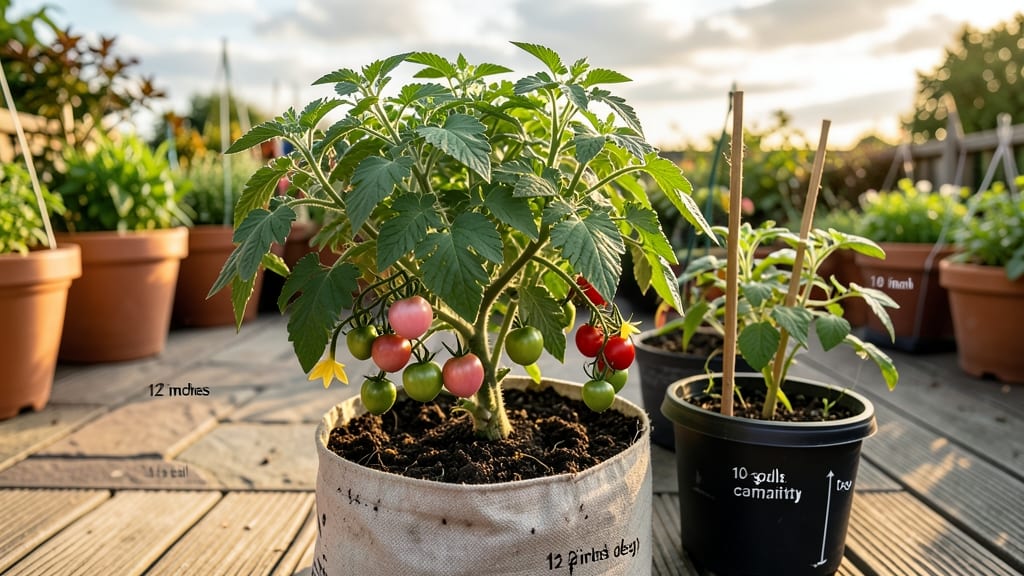
Growing cherry tomatoes in pots requires the right cherry tomato pot size—and skipping the 5-gallon minimum can mean smaller harvests or stunted plants.
If your 🍅 cherry tomatoes are struggling—or worse, producing sparse harvests—your pot size might be the silent culprit. A 5-gallon minimum isn’t just a recommendation; it’s the foundation for a flourishing vine and a bounty of sweet, juicy fruit.
Too small, and roots compete for space, leading to yellowing leaves and poor fruit set. Too large, and moisture gets trapped, inviting root rot. The key is balancing root space with drainage, especially in Zone 6a where spring warmth kicks off growth early.
In this guide, I’ll break down the ideal pot dimensions, how to upgrade containers mid-season without shocking your plants, and which varieties thrive in 3-gallon vs. 7-gallon setups.

Why 5-Gallon pots are the minimum for cherry tomatoes (and how to avoid common mistakes)
I’ve learned the hard way that cherry tomatoes in anything smaller than a 5-gallon pot are like trying to fit a marathon runner into a sprint lane—they’ll never reach their full potential.
These compact but prolific plants need space to grow strong roots, store nutrients, and produce the heavy fruit loads they’re famous for. Without enough room, your plants will show you exactly how frustrated they are: yellowing leaves, stunted growth, and—worst of all—tiny, underdeveloped tomatoes.
Let’s break down why 5 gallons is the magic number and how to spot when your pots are holding your plants back.
Root growth is the first casualty of small pots. Cherry tomatoes develop a deep, extensive root system to anchor themselves and access water and nutrients. In a 3-gallon pot, roots become root-bound quickly, circling the edges like a tangled mess.
This restricts water absorption and nutrient uptake, forcing your plant to compete with itself for resources. The result? Poor fruit set and a vine that looks more like a sad houseplant than a productive tomato plant.
Even dwarf varieties like 'Tiny Tim' need at least 5 gallons to thrive, let alone produce the abundant harvests we all dream of.
Nutrient depletion is another silent killer in small containers. Soil in tiny pots gets exhausted faster because there’s less volume to hold nutrients.
When your plant outgrows its pot, it starts mining nutrients aggressively, leading to deficiencies that show up as purple stems (phosphorus deficiency) or yellowing between veins (magnesium deficiency). Even if you fertilize regularly, the small soil volume can’t keep up with the plant’s demands.
A 5-gallon pot gives you a buffer, allowing you to fertilize less frequently while still supporting robust growth and fruit production.
Here’s the kicker: small pots limit yield in a way that’s hard to predict. I’ve seen Sweet 100 plants in 3-gallon pots produce maybe a dozen tomatoes over the season, while identical plants in 7-gallon pots yield hundreds. The difference isn’t just about quantity—it’s about fruit quality too.
Overcrowded roots lead to smaller, less flavorful tomatoes because the plant diverts energy to survival instead of fruit development. If your cherry tomatoes taste bland or stay tiny, your pot size is likely the culprit.
Now, let’s talk about how to diagnose underpotting before it’s too late. The first red flag is stunted growth. If your cherry tomato plant looks like it’s trying to reach for the sky but only grows a few inches each week, it’s begging for more space.
Another telltale sign is roots growing out of drainage holes. This isn’t just a quirky plant personality—it’s a cry for help. When roots escape, they’re searching for nutrients and water that the pot can’t provide. Finally, keep an eye on your fruit production.
If your plant is covered in flowers but only sets a handful of tomatoes—or worse, the flowers drop off—your pot is likely too small to support the energy demands of fruiting.
Yellowing leaves are another classic sign of nutrient stress caused by underpotting. If you notice lower leaves turning yellow first (a condition called chlorosis), it’s often a sign that the roots can’t access enough nutrients or water. Pay special attention to the leaf veins.
If the yellowing occurs between the veins while the veins stay green, it’s usually a magnesium deficiency—a common issue in crowded pots.
If the entire leaf turns yellow, it might be a general nutrient deficiency or even root rot from poor drainage in a pot that’s too small to handle the plant’s needs.
Poor fruit production is the most frustrating symptom of underpotted cherry tomatoes. Even if your plant looks healthy, it might be dropping flowers or producing small, misshapen tomatoes. This happens because the plant prioritizes survival over reproduction when it’s stressed.
If you’re seeing blossom end rot (black spots on the bottom of tomatoes), it’s often a sign of calcium deficiency caused by inconsistent watering in small pots. The solution? Upgrade to a larger container and improve your watering consistency.
A 5-gallon pot gives your plant the stability it needs to focus on producing the sweet, juicy cherry tomatoes you’re craving.
One of the biggest mistakes I see is assuming that dwarf varieties don’t need as much space. While it’s true that 'Tiny Tim' or 'Micro Tom' are smaller than 'Sweet 100', they still need at least 5 gallons to perform well. These varieties are bred for compact growth, but their root systems are just as extensive as their larger cousins. Skimping on pot size might save you a few dollars upfront, but you’ll pay for
Best pot sizes for cherry tomatoes by variety (and how to maximize space in small gardens)
Not all cherry tomatoes are created equal—and neither are their pot size requirements! Dwarf varieties like 'Tiny Tim' thrive in 3-5 gallon pots, while indeterminate giants such as 'Sweet Million' demand 7+ gallons to support their sprawling vines.
Choosing the right container isn’t just about size; it’s about matching your plant’s growth habit to its root space needs. For example, a 5-gallon pot might work for a compact variety, but the same pot will leave a semi-determinate plant like 'Sun Gold' struggling to produce fruit.
Let’s break down the ideal pot dimensions for your favorite cherry tomato varieties.
When space is limited—like on a balcony or patio—pot size becomes even more critical. A 5-gallon pot might seem generous, but it’s barely enough for a semi-determinate variety, which can grow 4-5 feet tall and produce hundreds of fruits over the season.
The key is to plan ahead: start with the right pot, or upgrade early to avoid stunted growth. For indeterminate varieties, which keep growing until frost, a 7-10 gallon pot is non-negotiable if you want a heavy harvest.
Even then, you’ll need to prune aggressively and use cages or trellises to manage their height.
Here’s a quick comparison of top cherry tomato varieties, their mature heights, and the ideal pot sizes to maximize your harvest—without taking over your garden:
| Variety | Type | Mature Height | Ideal Pot Size | Max Space-Saving Tips |
|---|---|---|---|---|
| Tiny Tim | Dwarf | 12-18 inches | 3-5 gallons | Hanging basket + prune suckers |
| Sweet 100 | Indeterminate | 4-6 feet | 7-10 gallons | Vertical trellis + 2 plants per pot |
| Sun Gold | Semi-determinate | 3-4 feet | 5-7 gallons | Stake + companion basil |
| Black Cherry | Indeterminate | 5-6 feet | 7-10 gallons | Self-watering pot + prune heavily |
| Gold Nugget | Dwarf | 18-24 inches | 3-5 gallons | Window box + fertilize weekly |
If your garden space is tighter than a 5-gallon pot’s diameter, don’t despair! Vertical training is your best friend. Use cages, trellises, or stakes to guide vines upward, freeing up floor space for other plants.
Pair your cherry tomatoes with companion plants like basil or marigolds, which deter pests and make the most of limited real estate. Self-watering pots are another game-changer for small spaces—they reduce watering frequency and keep roots consistently moist, even when you’re away.
Just ensure your container has drainage holes to prevent root rot, a common issue in overwatered pots.
For dwarf varieties, hanging baskets are a clever solution—they keep plants off the ground, improve air circulation, and make harvesting easier. Just be sure to water deeply every 2-3 days, as hanging pots dry out faster.
If you’re growing multiple plants in one container, space them 12-18 inches apart to avoid competition for nutrients. And remember: larger pots equal larger harvests, but they also require more water and fertilizer. Balance is key—especially when every inch of space counts.
One common mistake I see is underestimating root growth. A 5-gallon pot might seem roomy, but by midsummer, a semi-determinate plant’s roots will have filled it—and then some. If you notice yellowing leaves or stunted growth, it’s time to upgrade.
The good news? You can transplant mid-season with minimal stress if you water thoroughly before moving and prune back any damaged roots. Just avoid doing this during extreme heat or cold, when plants are already stressed.
With the right pot size and a few space-saving hacks, you can grow bountiful cherry tomatoes even in the tiniest of gardens. Start with the variety that fits your space, then train, prune, and companion plant like a pro.
Before you know it, you’ll be swimming in sweet, juicy fruit—no matter how limited your square footage. Happy growing! 🌱