
Companion Plants
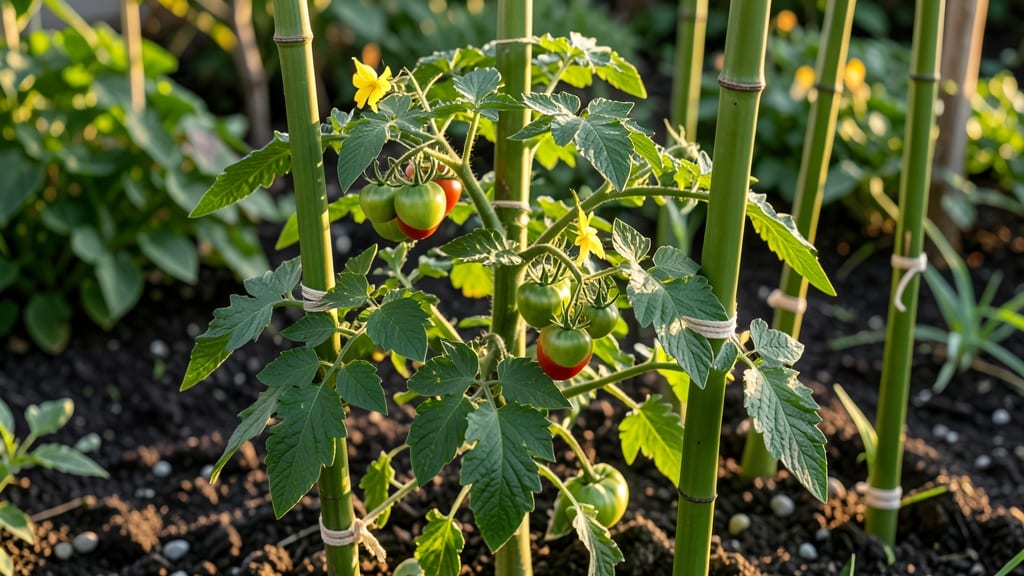
Using bamboo sticks for tomato plants 🍅 gives your heavy vines the sturdy support they need without the bulk of traditional cages.
Picture this: your tomatoes sprawling across the garden bed, their branches dragging in the dirt or snapping under fruit weight. It’s frustrating, especially when you’ve poured so much care into your plants.
Bamboo stakes solve this problem with a lightweight, customizable, and budget-friendly solution that keeps your vines upright and your harvests intact.
Why bamboo? Unlike wire cages, these sticks won’t rust, crowd your garden, or block sunlight. They’re easy to install, adjust as your plants grow, and even work in containers or small spaces. Plus, they’re eco-friendly and often cheaper than store-bought alternatives.
In this guide, I’ll walk you through how to choose the right sticks, set them up for maximum stability, and troubleshoot common issues like wind damage or uneven growth. Whether you’re growing indeterminate giants or compact cherry varieties, bamboo stakes can transform your tomato game.
How to properly use bamboo stakes for tomato plant support
Tomato plants can grow heavy vines loaded with fruit, making them prime candidates for support. Unlike rigid cages, bamboo stakes offer flexibility, affordability, and a natural look while preventing blossom end rot from uneven stress.
The key is proper installation—too short or flimsy, and your plants will still flop; too tall or rigid, and you risk damaging stems. Let’s break down the step-by-step process to maximize stability without stunting growth.
Before you start, gather your materials: 3-5 ft bamboo stakes (thicker than ½ inch for sturdy support), soft plant ties (avoid wire), and a mallet or hammer for driving stakes into the ground.
For indeterminate varieties, like 'Sungold' or 'Brandywine', you’ll need taller stakes (up to 6 ft) since these can reach 6-8 ft tall. Determine the height based on your plant’s mature size and your garden’s space constraints.
Timing is critical—wait until your tomato plants are 6-12 inches tall with 3-5 true leaves before staking. This ensures roots are established but not yet overburdened by fruit. Early staking can restrict root growth, while waiting too long risks vine breakage from sudden weight.
For determinate varieties, like 'Roma' or 'Celebrity', stakes can be shorter (3-4 ft) since they top out around 4 ft.
Step-by-Step Guide to Installing Bamboo Stakes
- 1 Choose the right stakes: Select 3-5 ft bamboo stakes (thicker than ½ inch). For indeterminate tomatoes, opt for 6 ft stakes to accommodate vertical growth.
- 2 Position stakes correctly: Place stakes 2-3 inches away from the main stem, angled slightly toward the plant’s growth direction. Drive them 6-8 inches deep into the soil for stability.
- 3 Secure the plant gently: Use soft plant ties (not wire) to loosely tie the main stem to the stake. Leave 1-2 inches of slack to allow growth without restricting the stem.
- 4 Add side support: For heavy fruit loads, tie secondary stems to the stake or use additional stakes in a triangle formation for indeterminate varieties.
- 5 Adjust as the plant grows: Loosen ties every 2-3 weeks to prevent stem girdling. Add stakes or ties if the plant outgrows the initial support.
Spacing between stakes matters just as much as height. For determinate tomatoes, place stakes 12-18 inches apart in a grid pattern to prevent overcrowding. Indeterminate varieties, which grow continuously, need 24-36 inches between stakes to accommodate their sprawling habit.
If you’re growing in containers, use 2-3 stakes per plant arranged in a triangle for maximum stability.
One common mistake is using stakes that are too thin or too short. A ½-inch diameter stake won’t handle the weight of a 6-pound tomato, while a 4-foot stake won’t support a 7-foot vine.
Always err on the side of extra height and thickness, especially for heirloom or beefsteak varieties, which produce larger fruit. If your stakes bend under the weight, reinforce them by tying two stakes together in an "A" frame.
Securing vines to bamboo stakes requires patience and the right tools. Avoid using wire or zip ties, which can cut into the stem and cause damage. Instead, opt for soft plant ties made of fabric or plastic strips.
Tie the vine to the stake every 6-12 inches as it grows, ensuring the tie is loose enough to allow the stem to thicken naturally. For side shoots, gently weave them around the stake or tie them separately to distribute weight evenly.
Wind can be a silent enemy of staked tomato plants. If you live in a windy area, consider adding additional stakes or using bamboo trellis panels for extra support. Bury stakes deeper than 6 inches and stake them together at the base to create a windbreak effect. For container-grown tomatoes, place the pot in a sheltered spot or use a weighted
Bamboo sticks vs. tomato cages: which offers better support?
Choosing the right support for your tomato plants can make or break your harvest. Bamboo sticks and tomato cages both serve the same purpose—keeping vines upright—but they do it in very different ways.
If you're working with limited space or prefer a natural aesthetic, bamboo might be your best bet. But for heavy producers like indeterminate tomatoes, cages could offer more stability. Let's break down the key differences to help you decide.
First, consider your garden layout. Bamboo stakes take up minimal space, making them ideal for small gardens or containers. Tomato cages, on the other hand, occupy more room around the plant, which can be a drawback if you're growing in tight quarters.
For determinate varieties, cages might suffice, but for tall, sprawling indeterminate types, bamboo sticks often provide better control over vine direction and growth.
Bamboo Sticks for Tomato Plants
- ✅ Space-efficient: Fits in small gardens or containers
- ✅ Eco-friendly: Biodegradable and sustainable
- ✅ Customizable: Adjust height and angle for vine growth
- ✅ Cost-effective: Cheaper than cages for large gardens
Cons
- ❌ Less stability: May require tying frequently
- ❌ Time-consuming: Need regular maintenance for tall vines
- ❌ Wind vulnerability: Can bend or break in storms
Tomato Cages
- ✅ Sturdy support: Handles heavy fruit loads well
- ✅ Low maintenance: Less frequent tying needed
- ✅ Good for determinate: Ideal for bushier varieties
Cons
- ❌ Space-hogging: Takes up more garden real estate
- ❌ Less flexible: Can restrict vine growth direction
- ❌ Less aesthetic: Wire cages can look cluttered
When it comes to cost, bamboo sticks are the clear winner for most gardeners.
A bundle of 3-foot bamboo stakes costs just a few dollars and can be reused year after year. Tomato cages, however, often require a larger upfront investment, especially if you're buying high-quality galvanized wire cages.
For large gardens, the cumulative cost of cages can add up quickly, making bamboo a more budget-friendly choice over time.
Durability is another critical factor. Bamboo sticks are lightweight and can bend under pressure, which might not be ideal for heavy tomato varieties like beefsteaks.
If you live in an area with strong winds or frequent rain, you might need to secure stakes with twine or clips to prevent them from toppling. Tomato cages, made from sturdy wire, handle wind and weight better but can rust over time if not treated properly.
Ease of use is where cages often shine. Once installed, they require minimal maintenance—just the occasional tie-down as the plant grows. With bamboo stakes, you'll need to monitor vine growth closely and adjust ties regularly to prevent flopping.
However, bamboo offers more flexibility in training vines, allowing you to guide them in specific directions, which can be beneficial for maximizing space or creating a vertical garden.
For container gardening, bamboo sticks are almost always the better choice. Their slim profile makes them perfect for 5-gallon buckets or fabric grow bags, where cages would take up too much space.
If you're growing cherry tomatoes or other compact varieties, cages might work, but for anything taller or more sprawling, bamboo is the smarter pick.
Ultimately, the best choice depends on your specific tomato varieties, garden space, and personal preferences. If you prioritize aesthetics, space efficiency, and eco-friendliness, go with bamboo.
For heavy producers or low-maintenance support, cages might be the way to go. Experiment with both in different sections of your garden to see what works best for your tomato plants this season! 🌱